

Lightning arresters are a crucial component of building lightning protection systems, with single-tube lightning arresters being a common type. This structure uses a single metal support as a lightning discharge channel, and its functionality relies on precise design calculations. The support is typically made of galvanized steel or alloy steel, and its cross-section and height must be matched to the protected area and the intensity of local lightning activity.
Compared to lattice towers, single-tube structures reduce the number of connection points. This characteristic allows for more direct stress distribution under wind loads, but also places higher demands on the bending and torsional resistance of the support itself. Foundation design considers soil resistivity and tower overturning moment, typically employing independent concrete foundations or pile foundations to ensure structural stability under lightning current impact and severe weather conditions.
The core of the lightning interception process is the coordination between the down conductor and the grounding system. The tube itself of the single-tube tower acts as a natural down conductor, with current discharging along its surface. The grounding device typically uses a ring or radial horizontal grounding electrode connected to the tube foundation to rapidly diffuse high-potential lightning current into the soil, reducing grounding resistance and preventing side strikes or backflashovers.
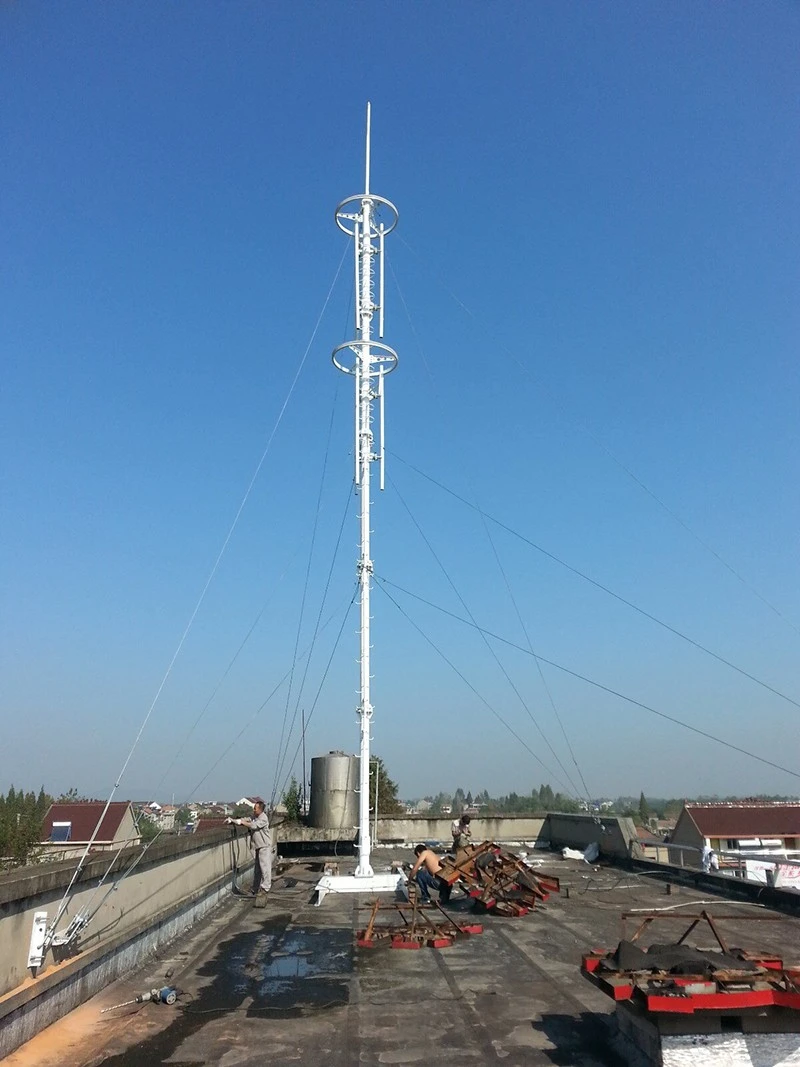
In practical applications, single-tube lightning arresters are commonly found around communication base stations, independent warehouses, or facilities in open areas. Their site selection requires comprehensive consideration of protection angle calculations and the impact of spatial obstacles. The protection range can be geometrically described using a rolling sphere model; increasing the tower height expands the protection radius, but structural strength and grounding effectiveness must be enhanced simultaneously.
Operation and maintenance focus on material durability and connection reliability. The metal tube body needs regular inspection for plating damage due to weathering or lightning strikes, and grounding resistance should be measured periodically to ensure its value remains within design requirements. In highly corrosive industrial or coastal environments, additional anti-corrosion measures are required to extend service life.
From an engineering economics and environmental adaptability perspective, single-tube lightning arresters offer advantages such as relatively simple installation and smaller footprint. Their design must strike a balance between protective effectiveness, structural safety, and cost control. Different geographical and meteorological conditions directly influence the selection of specific parameters, explaining why there is no universally applicable standard design scheme.